The late 19th through mid 20th
centuries in Germany were a period of rapid, dramatic change in leadership and
position in the global community. In less than a century the nation became
unified, lost a war that came with terrible economic and social setbacks,
created a short-lived Republic, attempted to regain global power (and turning
into the most feared nation in the world), and ultimately being defeated once
again. Nevertheless, through all of this tumult Germans managed to remain
positive that their nation could be one of great power and prosperity, one that
would support its citizens through thick and thin and bring them the futures
they had dreamed of.
One topic that will always remain interesting to me,
however, is how the German people were able to subscribe to the messages given
by the Nazi party. It has always amazed me that an entire nation (or at the
very least, a large majority of it) could stand behind a man whose arguments
were so incredibly flawed. Naturally, everything seems more obvious in
hindsight, but still—what did the National Socialist Party preach that was so
effective?

"Long Live Germany!" Reads the text beneath a portrait of Hitler proudly holding a billowing National Socialist Party flag. Propaganda played a major role in the Nazi Party takeover, particularly among the working class who strove to have a ruler who was of the people, not just in charge of them.
The answer has multiple layers, and Hagen Schulze addresses
quite a few of them, specifically in Chapters 11 and 12 of Germany, a New History. To
start, Hitler’s more conservative contemporaries didn’t view him as much of a
threat. Almost no one had read Mein Kampf,
and to those who did it seemed to follow a tradition of large gaps “between ideological
declarations of principle and practical political strategy” (p. 246). Other
dictators at the time, such as Mussolini in Italy, were receiving primarily
positive commentary from both outsiders and those being governed, making
National Socialist Party look to be more of the same. If anything, those who
opposed Hitler assumed that he would not last long in government, and they
would soon be able to replace him.
Naturally, then, when Hitler established irreversible rule
for the National Socialist Party, chaos should have ensued. Once again,
however, his dissenters had no idea of the gravity of the situation. As opposed
to an immediate takeover, the National Socialist Party’s “seizure of power”
took almost two years to complete (p. 247); with so much time to mull over
changes, it appeared as though barely any changes were happening at all. Once
again, it seemed as if Hitler and his Party were changing nothing, and would
soon be gone.

Hitler's election was considered a victory to the laboring class, but the upper crust were considerably less enthused. Nevertheless, they saw "Herr Hitler" as more or less of a fad, someone who would be fairly ineffective and fade away quickly, allowing the more conservative politicians a chance to return to power.
Fairly soon it became obvious, though, that the National
Socialist Party would not be going anywhere. After a complete and thorough
government takeover on all sides, the Party began to instill a certain amount
of fear in the hearts of the people. Books and artwork from “offending parties”
were burned, undesirable music was banned, and propaganda against such “degenerate”
items was spread quickly and efficiently. The people of Germany could not
escape the social pressure to conform to the Party’s scheme. This included the alienation
of those who were not “completely German,” the German Jews (p. 252-253). Just
as the Party aimed to eliminate objects that did not fit into the image of
Modern Germany, so were the people cast off and pushed out.
But why did the people stand for such radical change and
oppression? The most likely answer is that, at the same time as the violence
and oppression, enticement and fascination were being used to draw in support.
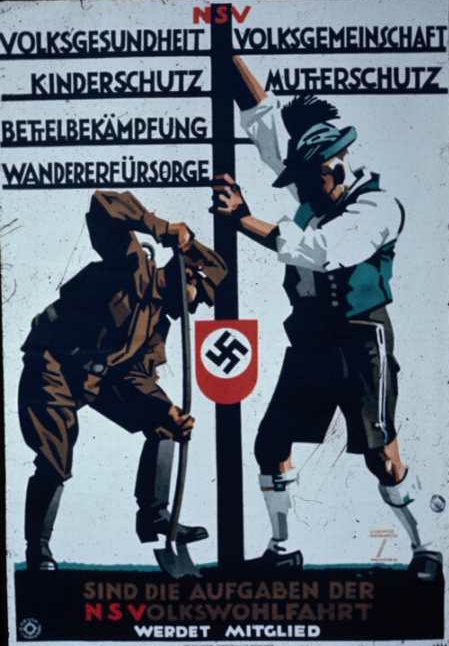
Nearly every social group, political interest or collective hope was benefitted
by the National Socialist Party in some way (p. 256), whether that be
job-creation programs for laborers, higher taxes on larger businesses to
support smaller ones, or the elimination of labor-conflicts with unions. All
across the nation German people were rewarded not only with financial gains,
but a sense of solidarity.
It makes sense, then, that so many Germans supported the
National Socialist Party. Playing both good cop and bad, the Party under Hitler
was able to infiltrate the minds of Germans everywhere and inspire hope for a
new, stronger nation, born out of the dredges of WWI. The people had not had
this much success and reward since the Unification in 1871, and it seemed as if
the country was finally turning around.

The text on this poster reads, "With our flags is the victory!" and served as a reminder to Germans that, just a few years ago, they had lost a war that put them in the desolate state they were in today. Calling for victory meant retaliation against those who had taken so much from the Germans, but it also meant the protection given by a party that had not lost the previous war.
Perhaps, then, if they had known how damaging the results of
the National Socialist Party’s actions would be on a national and global scale,
they would have chosen to act differently; no one can really know, however, what the effects of the German nation would be today had the National Socialist Party not united Germans when they did in the ways they did.
