About Me

My name is Sarah and I'm a senior music and theatre major at North Central College. I am finally doing what I've been waiting for since middle school: I'm studying abroad! We will leave for Germany on December 1 and spend three weeks in the homeland of many of my favorite composers: Bach, Beethoven, Schumann, the Mendelssohns, Weissenborn...the list goes on.
I hope to learn something new about the past masters to help me along my musical journey. Let's see where we go!

Tuesday, December 9, 2014

Day 7: Leaving the City

Today we traveled to the city of Dresden, in the state of Saxony. While this was not technically the first time we left Berlin (we have gone to Potsdam twice now), the two hour train ride meant that, for the first time, we were definitely outside the city.

We left very early in the morning, and took the nicest train we've had so far: the German equivalent of an Amtrak. We had a paper due by the end of the evening, but Dr. Wolf invited me to go to the dining car with him, so I took the opportunity. The tea was lovely (not to mention inexpensive) and I had a great conversation with him and Chelsea...so the paper could wait.

When we arrived we had some free time for lunch. We could go wherever we pleased, but those of us who stayed with Dr. Wolf participated in a "culinary excursion." We walked around the downtown Dresden Christmas Markt, and when he saw a food he thought might be new to us, he bought a sample and we all tried it. By the end of lunch I had eaten wild ram sausage, horse patties and kebab, candied almonds, waffeln, and some sort of marshmallow dessert with amaretto inside. Sehr wunderbar!

After lunch he took us on a walking tour of the historic downtown area. We saw palaces, entered one of the few Catholic churches in northern Germany, and saw the "panorama" view that has made Dresden so sought after. It was beautiful, yes, but it was also sad to think that nearly every building had been reconstructed, because the city had been completely decimated during the war. What's more sad is that Dresden had no soldiers, only civilians, most of whom were refugees from other destroyed cities, and yet was still fire bombed by American troops in order to destroy German morale. In most cases this would have been tried as a war crime--but who is going to try the winners?

That being said, a lot of effort has gone into restoring the historic city. Much of this restoration was done by the Soviets, despite the fact that they rarely restored anything due to lack of funds. This was primarily because these restored landmarks would draw in tourists from other countries, which would in turn draw in international currency needed by the east Germans. One such building was the Semper Opera House, named after the original architect. This building was painstakingly restored, using methods not unlike those used when it was originally built. This place is everything I've ever dreamed an opera house of being...gilded, sculpted, and frescoed to the absolute max, the Semper Opera House is an absolute spectacle! It is still used today (Mozart tonight!!) and sells over 90% of its tickets each year. I really enjoyed going to the opera last night, but there would be no comparison to seeing opera in a place like this. I would LOVE to come back here and see an opera in this historic place!

After the opera house we had free time. So Jessica, Emily, and I went to a Swiss alpine restaurant and got a bite to eat. It was really good, and the hot chocolate was delicious! They put chocolate liqueur, whipped cream, and chocolate shavings in it...yum. I have noticed that Germans seem to love putting alcohol in hot chocolate. And I don't mind one bit--it warms you right up!

We went home then and I finished my paper on the train, so I managed to sneak in a little nap. It has been a wonderful day. I can't wait to see what tomorrow brings!

Day 6: A Day of Culture

Today started off in a rush--my alarm didn't go off, so I had to move quickly to make breakfast in time. Luckily for me, however, we had our last meeting time so far, so I still had enough time to get ready.

This morning we went to the historic Reicchstag building, home of the German Parliament, or Bundestag. The exterior of the building dates back to the late 19th Century, when the original Reichstag was formed. This building was incredibly ornate and exceedingly overdecorated...the architect wanted to incorporate aspects of every German region, so there was a little too much of everything. This fancy building, however, was not much more than a facade--the King of Prussia was really the one in charge, but he wanted the people to think they had some control.

In the 1930s the building was destroyed by arseny--thus the Nazis never used it for their work. It lay in relative ruin until the 1960s, when the interior was used for general offices. In the 90s, when the Re-Unification called for the transfer of the Bundestag to Berlin from Bonn, the Historic Reichstag building seemed to be the perfect choice.

The interior, and some of the exterior, would need to be completely redesigned, and British architect Norman Foster won the bid for the job. He left only the outer walls remaining, and the interior he made clean and modern. Even from 250 meters away, one can see clear into the Plenary Chamber where parliament meets, fulfilling the Germans' wish for government transparency. Indeed, that is the theme for the whole design: the parliament, employees of the people, should never be able to hide.

I am envious of Germans' ability to visit their government. They can visit while parliament is in session and sit in one of the 250+ seats open to visitors. They can also tour the dome, the only modern element visible from the outside, which is completely made of glass. Visitors such as us are always allowed inside the dome, so that when parliament is in session they can see, upon looking up, the people they are making decisions for.

After learning about modern Berlin, we learned some history. We next travelled to Charlottenburg, the palace of Sophie Charlotte. Oh my gosh! My biggest (nay, only) regret of the trip so far is that I didn't pay the 3€ charge to take photos. The palace was SO AMAZING. Gorgeous harpsichords, miles of drapes, and an entire room filled to the brim with porcelain--this was only the few rooms we saw out of hundreds, many not yet restored. The best part, though, was the ceilings, most had gorgeous frescoes, but some even had 3-D elements, such as clouds or cherub legs or even a deer head, to make them appear real. Sehr interessant! 

Afterwards, the rest of the group went on a walking tour, but Emily and I left to go to the opera. We planned to attend the Deutsche Opera Berlin (Berlin City Opera) production of "Tännheuser," but due to some unusual events we ended up both getting lost and going to the wrong place...so by the time the 5:00 start time rolled around we were on the wrong side of the city, standing outside the National Opera House, opening after reconstruction in 2015. Luckily for us, though, the Staatsoper Berlin (Berlin State Opera, a step up) was selling tickets outside their home Haus for their 6:00pm show.

We bought two student tickets, hopped onto the nearest bus, and rushed over to the Schiller Theatre for a performance of Janacek's "In the Death House." The production was amazing: the sets were brilliant, the orchestra perfect, and the ensemble stunning. It was such a great experience, even if we didn't understand a word of it!

Afterwards Emily and I went to Zillemarkt, a lovely turn of the century restaurant and pub, for Schnitzel and a beer. Sehr groß! We split an order, and thank God we did--it was huge!

Today was an awesome day. I got to experience so many different elements of German culture, and enjoyed every second (I feel like I've been saying that every day...oh well). Tomorrow we travel outside Berlin for the first time, to the city of Dresden...I can't wait! Schuss! 

Monday, December 8, 2014

Day 5: A Little Bad, a Lot of Good

This morning we visited Hohenschönhausen, a Stasi prison. Until the early 1990s, no East Germans even knew that the prison was there, as it was in a Soviet blackout zone--the area was not on any maps, and all surrounding buildings with views into the Stasi zone were filled with the homes of Stasi members in order to protect its secrecy. As a result, nonoe of the prisoners who were sentenced there even knew where they were located, making their stories both tragic and recent.

The prison is comprised of two main parts: the Submarine, or old building basement, was the first prison section. These rooms had no windows to the outside, often filled 4 people to a tiny room, and were dark and dank. Prisoners housed inside at this time were often subjected to physical torture. After this period, however, the prisoners sentenced to hard labor built the New Building.

This New Building had the capacity for windows, but also for complete terror. Prisoners here were not subjected to physical torture, but rather torture of the psychological kind. Before entering the prison, for crimes anywhere from trying to read a Western newspaper to not turning in school assignments, prisoners were kidnapped in a norma-looking van with no windows, driven around for upwards of three hours, and then brought immediately into the prison. They were sleep-deprived, barely fed, and provoked to becoming rowdy, all before being interrogated in every way possible. They would be routinely awoken in the middle of the night, were not allowed to make any noise, and would interact with absolutely no one except the interrogators through their entire stay and sentence. Even in their 20-minute sessions in the outdoor walking "tiger cages" one could not make noise...two weeks could be added to a sentence for coughing. No one ever escaped, making entering this prison even more despairing.

There were so many horrible things learned today, but one thing I found surprising was that Mychal's own brother spent time in this prison. One day he disappeared, and his family had no idea where or why. It was not until several weeks later that his teacher contacted the family and told them he had been arrested at school. The Stasi had spies, microphones, phone taps...and they managed to find out that the teacher gave information, which was treason, so the teacher was arrested, too. It is strange to think I am only a few degrees away from someone who spent time in this awful place.

After visiting the prison we were given free time to visit any museum of our choice. After grabbing a delicious lunch of fish and chips at an Irish-style pub, Emily and I went to the Neue Museum, dedicated to Ancient Egypt, Prehistory, and Early History through the Roman empire. This museum was AMAZING! It has been housed in the same building since the 1800s, but due to destruction in the War much of it was destroyed. Therefore the inside is now partially reconstructed, much like the New Synagogue, so that you can both see the opulence that once graced the walls and reflect on what history has done to them. The museum has a phenomenal collection of ancient artefacts, and it was here that I began to notice the distinctly German way of organizing museums: rather than displaying items by country, they are displayed by date and thematic similarity. It really made for a unique museum experience, and was actually a lot more sensical. I am so glad we chose that museum!

Following this we travelled back to Potsdam (my favorite place so far) and went to a Bach concert in the Erlöser Church. The church is very old, and happens to be in the seat of one of Bach's favorite places in the world (he named the Brandenburg Concerti after this state!). Hearing the Weinachtsoratorium (Christmas Eve Oratorio) in this beautiful old church was honestly one of the most authentically German music experiences I've ever had. And to top it all off, Mychal was in the choir! There was a lovely Christmas Markt outside the church where we had a lovely dinner before and got to talk with Heika some more, and then attended the concert of the first three "Teils" of the Oratorio. Sehr gut!

Following this, Emily, Jessica, and I went into downtown Potsdam to explore a bit, since it was Saturday night, after all. We first went to the Cafe Franz Schubert so I could take some pictures...man, I wish I could go there when it was open! A cafe dedicated to my all-time favorite (and don't forget German) composer, and so cute inside! But I'm glad I at least got to see it. We walked through the Markt, and then through downtown, before catching a tram to the Hauptbanhof (main train station) and taking the S-Bahn (elevated train) back to our hotel.

The evening in Potsdam was a wonderful way to counteract the dreary morning, and I really enjoyed this day. Tomorrow I travel to the opera...I can't wait! It's going to be amazing! Auf Wiedersehn!

Sunday, December 7, 2014

Day 4: A Little Taste of Home

Today was our first time out of the city of Berlin since the start of the trip, and I think we were all a little excited to get outside of the city buzz for awhile. We travelled to the city of Potsdam in the state of Brandenburg, where we walked more in one half day than I've probably ever walked in my life (cue the tylenol and glühwein!). We learned about much of Potsdam history, both from the 18th century and the 20th.

We started in the morning at Park Sanssouci, home of many of the palaces and gardens of Frederic der Große and Frederic Wilhelm. We walked for several hours through the park, visiting many palaces, a Roman Bath (that was purely for decoration!), a Chinoiserie-style Tea house, an Orangerie (place to store fruit plants in the winter, sort of like a greenhouse), and more. We learned all sorts of history about Frederic the Great, the king who brought the Enlightenment to Prussia. Frederic was most notably friends with Voltaire, as well as many other prominent philosophers. THis influence spread to Berlin and other parts of otherwise conservative Germany, causing periods of religious tolerance, promotion of higher education, and cultural booms. Frederic's palace, the original Sans Souci (meaning without troubles), was beautiful, but what I found most interesting was his descendant's home, the New Palace. Constructed shortly after war, materials were short, but FW wanted to show everyone that his kingdom was still mighty, so he constructed a new palace. However, in order to cut back on costs, he had many of the "bricks" of the outer walls painted onto flat plaster! Shortcuts like this made building an elaborate palace possible on a tighter budget.

For lunch we went to a small cafe in downtown Potsdam (sehr schön!), and after we took a tour of the city itself, which is currently one of the wealthiest cities in Germany. This is probably the best time to say a word about our tourguides, Mychal and Heika. They are great friends of Dr. Wolf, and Mychal is also a partner with North Central, occasionally teaching seminar classes back in Chicago. His wife, Heika, grew up in West Berlin before the fall of the wall, and Mychal grew up in Potsdam, part of East Germany. The tour through Potsdam showed us the many different neighborhoods of Potsdam, and both Mychal and Heika were able to give us some context, Heika about the 18th century Prussian origins, and Mychal about the city's state before the fall of the wall. It was fascinating to learn so much about life in East Germany, and it was so amazing to hear firsthand accounts of people who were actually at the protests for the removal of the wall.

Mychal's father was a pastor, and the Church in East Berlin was one of the few ways that people could come together to exchange ideas, particularly anti-regime ones. Everyone from artists to punk rockers, LGBTQIA individuals to political dissenters gathered in churches to talk about what was going on and what could be done, and Mychal was right in the middle of it. His own brother was arrested by the Stasi, and no one could even tell his family that he had been taken or where he had gone, for risk of being kidnapped themselves.

After learning about all of this, we were taken to their home in the Dutch Quarter, where they have a lovely flat in what used to be an organ-maker's shop. They live there with their three young children, and Friday late afternoon they invited us into their home for an absolute feast of cookies, candies, cakes, fruit, and all sorts of drinks, ranging from coffee and tea to Glühwein and Schnaps. The spread was beautiful (oh my gosh the food!) but what was even more amazing was the love and kindness shared with us by people who we had just met. By the end of the evening we truly felt as if we were old friends, and they were the most amazing hosts.

After a couple of hours many of our students went to a hockey game, but the few of us who stayed behind remained at their home a bit longer. We helped clean up a bit, sat around for a bit more, and then when we finally left we decided to go to Hackeschermarkt for some fun. We rode the Ferris Wheel, I ate Goulash, and we even got some desserts (I finally tried Quark! Yum!). It was a lovely evening.

Today was an amazing day, and I'm so glad to have been able to have spent it with such wonderful hosts. Potsdam is an amazing city, but what made it so special was their hospitality and kindness. It certainly won't be forgotten.

I must go to sleep as we have an early start tomorrow. Tschau!

Saturday, December 6, 2014

Day 3: Very Long (And Very Awesome)

Today we learned a lot about Nazi Germany from a variety of perspectives. It was one of the most fascinating days I've had so far. In the morning, we started by going to the Berlin Underworld Museum. The actual museum is located in one of the remaining WWII civilian bunkers, so we climbed down below, deep into the concrete tunnels...

The exhibit was primarily based upon the lives of German civilians during WWII, comprised mainly of women, children, and the elderly. We learned about Rubble Women, who earned food stamps for moving rubble away from bomb sites. We also learned about the serious lack of space in bunkers around the country, the 50€ the government charged for a gas mask for your child, and the complete and utter disrespect for Eastern Europeans, essentially forced into slavery by the Third Reich. But what I found most interesting was the fear of responsibility forced upon Germans during the War: an immense weight was put on Germans to "do their share" to aid the war effort. Failure to black out windows properly, for example, could result in humiliation the first time; a second offense, though, and you could be tried in court for treason. I found it shocking to get a glimpse of life for Germans at such a time--a side of the war Americans rarely talk about. We tend to picture Germans as angry Aryan Nazis, killing everyone in sight; we rarely see mothers walking down streets with gas mask baby carriers.

Following the tour we visited a WWII watchtower. We climbed up the GDR-made hill to the top, where we saw an amazing view of the city while contemplating the fear created by such a structure. Then we split into small groups and went for lunch in the Turkish neighborhood. Sehr gut! We had an amazing time, and I enjoyed some amazing food. Dr. Wolf made us split into new groups, and I'm so glad he did--all of us were able to make some new friends.

After lunch we had to deviate from our plan because of interrupted train routes, so Wolf took us back to Mitte, the former Jewish Quarter, for a walking tour. It is now an up and coming neighborhood for young urbanites and upscale young families, as most of the homes and buildings have been reconstructed since the reunification. And yet some untouched buildings remain, like ghastly shadows amongst the gleaming refurbished structures. In the case of many of these properties, once beautiful homes for wealthy German Jews, the last property owners (who most likely fled after the Soviet takeover) before the communist regime have not been located, so no one is available to spend the funds necessary to rehabilitate the buildings. It is amazing to think that 25 years ago (or even less), ALL of these buildings were like this, falling apart at the seams and in utter disrepair. It must have been such a shock when the first ones were rehabilitated; I would imagine that after spending decades gazing at grey, so many colors and textures would be quite the surprise.

While on the tour we also stopped at a memorial for the Berlin Jews taken to concentration camps. In the site of the memorial alone, over 55,000 Jews were rounded up and taken to concentration camps. As is fitting with Jewish tradition, many people had placed stones on the memorial in remembrance. It was so moving to be able to place a stone on the memorial--the site of remembrance for these thousands who were stolen from their homes and their families, most to never return.

When we finished our walking tour we went to our last stop of the day, the Topography of Terror Museum. The museum is situated on a corner with four important historical buildings: the Prussian Parliament building (now a state parliament building), a minor prince's palace (now a Bauhaus Museum), a small portion of the Berlin Wall, and the Luftwaffe Headquarters (now a government building). The land plot itself was once SS Headquarters; the building was demolished, and a museum about the Nazi regime was built in its place.

Our tourguide at this museum was phenomenal; he took us through many parts of the museum dedicated to understanding how the National Socialists came to control an entire nation and start a World War. We learned so much about how the Regime worked, and how, essentially, it could happen again if we are not cautious. It was scary, and it was sad, but it was so very interesting. Learning about the "bad guys" happens all of the time in the US, but we don't very often stop and think about why they managed to get a following in the first place. This was a serious and dark museum, but it was fascinating just the same.

To end a long and difficult day, many of us went to Gendarmenmarkt, one of the nicest Christmas Markets, to celebrate one of our group member's birthday. We ate bratwurst, heard a choir, and visited what must have been hundreds of shops. But the best part was when, while looking at some beautiful wool handwarmers at a stall, I had a conversation with a shopkeeper who thought I was a native German speaker for a good minute or so! She eventually asked me something I didn't understand, so I asked what she said, and we talked for some time. She was so nice, and suprised that I came from America. One of my goals forthis trip was to become more comfortable speaking German, and I really have been! By the time I leave I'm going to be so good at it (if only my vocab would learn itself!), and I'm so excited for that.

All in all today was amazing. I'm having a much better time now that I'm adjusted. I can't wait for tomorrow, our first time leaving Berlin since we arrived. Schuss!

Thursday, December 4, 2014

Day 2: Ups and Downs (and ups and downs and ups and downs...)

It's the end of day two, and I've seen so many things. I will summarize my amazing day, since I didn't have a lot of time to write.

This morning, I started off the day thinking I'd lost my change purse. It only had a few € in it, but I was frustrated. 
On top of that, my phone still wasn't phoning, and I had no idea when I'd be able to do something about it, so I was really nervous about that. 

But then we went on our trip for the day, and it was amazing.

We started off the day in the Berlin Cathedral, which is absolutely gorgeous. A protestant cathedral built for the King's private worship, the cathedral today is more museum and musical performance space than house of worship. But what a sight to behold.
We saw the interior with the first of what I'm sure is going to be many simply STUNNING pipe organs. This is becoming a slight fixation of mine (and possibly a topic for a final paper??), because they are more amazing than I could ever describe with words. Hundreds of pipes displayed more gracefully than I've ever seen.
We then travelled up to the dome, where we stood outside on a (well-guarded) ledge and saw most of the city from above. Amazing views! We could see Christmas markets, many construction zones, and gorgeous historic buildings, all from above. 
Next we traveled to the basement, where we saw the caskets of many of the old German royal family. the crypt was more than a little spooky, but it was also beautiful in the way that the Germans have preserved pieces of their history wherever they can.

Before lunch we also traveled to several places, including Humboldt University (the Harvard of Germany, according to Dr. Wolf). We saw halls where Einstein has lectured, and then stopped by a memorial for all of the figures of the university who were killed in WWII. Many more (Einstein included) were forced to emigrate to the USA and other countries. 

We also travelled to St. Hedwig's Catholic church, one of the only Catholic churches in Northern Germany. the church, built during the Enlightenment, was completely destroyed by bombs in WWII, and was only recently renovated. This was the second home of a stunning pipe organ, and was generally awesome because of it's split level design.

We stopped by several other exciting places, including the memorial to the Nazi Book Burning site, which was breathtaking, and then got a break, during which I tried Russian Hot Chocolate for the first time: hot chocolate with rum! It was so delicious, and really warmed us up. 

Many of us skipped lunch to see the German History Museum (which was AMAZING) and afterwards we went to the New Watchtower Memorial, a memorial to all victims of all wars, constructed in 2010. But the most amaying thing we saw yesterday was the New Synagogue.

The New Synagogue was once the largest and most ornate synagogue in all of Europe. It had thousands of members, and was a highlight in its community. But during WWII it was destroyed, and not until recently was it reconstructed. The participants decided not to completely rebiuld the synagogue, however; they wanted to highlight the permanent damage created by war and hate crimes. The past cannot be undone or forgotten, so the engineers decided to honor what was lost by creating a new space that was part prayer room, part museum. The result was breathtaking.

Following this we went to dinner at what is probably the oldest brewery in the world. The food was excellent, but the beer was OUTSTANDING! It was such an amazing end to the day.

When I went home I found my change purse...WHEW. But still no luck with the phone. But all in all a great second day in Deutschland.

I will catch up on my day three when I can, but right now I need some sleep...we have a very early start tomorrow. Auf Wiedersehn!

Day 1: The Adventure Begins

Today I've done the following:

1. Traveled to two foreign countries.
2. Gotten my passport stamped for the first time.
3. Ridden in a German taxi.
4. Stayed at a German hotel.
5. Taken the S-Bahn.
6. Gone to the West Berlin Soviet War Memorial.
7. Gone to the Brandenburg Gate.
8. Gone to a bunch of government buildings and Embassies.
9. Gone to a Christmas Market.
10. Drank Glühwein at a German Christmas market. From a fancy mug.
11. Eaten schnitzel at a German (and Italian and Middle Eastern???) restaurant.
12. Eaten a food I can't pronounce or spell (it involved chocolate and marzipan...yum).
13. Gone tubing down a giant snow hill in the middle of Pottsdammer Platz. Twice.
14. Gone to an internet cafe.

All of that and I can't even get my phone to display the correct time.

This has been an amazing (not to mention 30-hour) day.

*This post was written on December 2nd, but due to crappy internet and phone problems this was the first time I could post it.*

Tuesday, November 11, 2014

Post 6: Pack Mentality and Support for the National Socialist Party

The late 19th through mid 20th centuries in Germany were a period of rapid, dramatic change in leadership and position in the global community. In less than a century the nation became unified, lost a war that came with terrible economic and social setbacks, created a short-lived Republic, attempted to regain global power (and turning into the most feared nation in the world), and ultimately being defeated once again. Nevertheless, through all of this tumult Germans managed to remain positive that their nation could be one of great power and prosperity, one that would support its citizens through thick and thin and bring them the futures they had dreamed of.

One topic that will always remain interesting to me, however, is how the German people were able to subscribe to the messages given by the Nazi party. It has always amazed me that an entire nation (or at the very least, a large majority of it) could stand behind a man whose arguments were so incredibly flawed. Naturally, everything seems more obvious in hindsight, but still—what did the National Socialist Party preach that was so effective?

"Long Live Germany!" Reads the text beneath a portrait of Hitler proudly holding a billowing National Socialist Party flag. Propaganda played a major role in the Nazi Party takeover, particularly among the working class who strove to have a ruler who was of the people, not just in charge of them.

The answer has multiple layers, and Hagen Schulze addresses quite a few of them, specifically in Chapters 11 and 12 of Germany, a New History.  To start, Hitler’s more conservative contemporaries didn’t view him as much of a threat. Almost no one had read Mein Kampf, and to those who did it seemed to follow a tradition of large gaps “between ideological declarations of principle and practical political strategy” (p. 246). Other dictators at the time, such as Mussolini in Italy, were receiving primarily positive commentary from both outsiders and those being governed, making National Socialist Party look to be more of the same. If anything, those who opposed Hitler assumed that he would not last long in government, and they would soon be able to replace him.

Naturally, then, when Hitler established irreversible rule for the National Socialist Party, chaos should have ensued. Once again, however, his dissenters had no idea of the gravity of the situation. As opposed to an immediate takeover, the National Socialist Party’s “seizure of power” took almost two years to complete (p. 247); with so much time to mull over changes, it appeared as though barely any changes were happening at all. Once again, it seemed as if Hitler and his Party were changing nothing, and would soon be gone.

Hitler's election was considered a victory to the laboring class, but the upper crust were considerably less enthused. Nevertheless, they saw "Herr Hitler" as more or less of a fad, someone who would be fairly ineffective and fade away quickly, allowing the more conservative politicians a chance to return to power.

Fairly soon it became obvious, though, that the National Socialist Party would not be going anywhere. After a complete and thorough government takeover on all sides, the Party began to instill a certain amount of fear in the hearts of the people. Books and artwork from “offending parties” were burned, undesirable music was banned, and propaganda against such “degenerate” items was spread quickly and efficiently. The people of Germany could not escape the social pressure to conform to the Party’s scheme. This included the alienation of those who were not “completely German,” the German Jews (p. 252-253). Just as the Party aimed to eliminate objects that did not fit into the image of Modern Germany, so were the people cast off and pushed out.

But why did the people stand for such radical change and oppression? The most likely answer is that, at the same time as the violence and oppression, enticement and fascination were being used to draw in support. Nearly every social group, political interest or collective hope was benefitted by the National Socialist Party in some way (p. 256), whether that be job-creation programs for laborers, higher taxes on larger businesses to support smaller ones, or the elimination of labor-conflicts with unions. All across the nation German people were rewarded not only with financial gains, but a sense of solidarity.

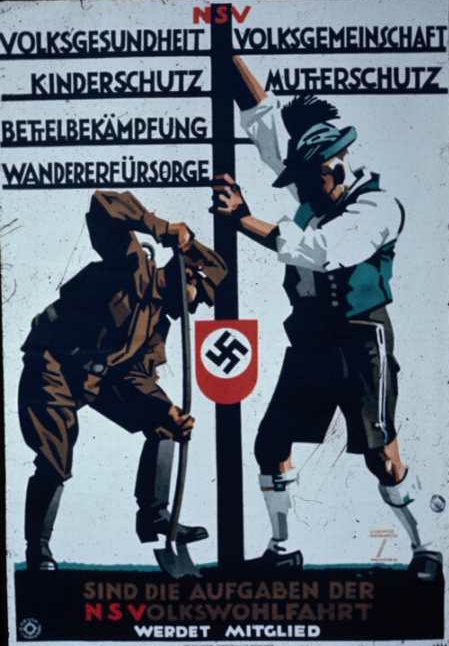
This poster advertises the many roles that the National Socialist People's Welfare provides its members, including, healthcare, community development, child and maternity care, and the natural environment. Posters such as this served to remind Germans that the National Socialist Party was helping them not only to thrive personally but to build community. For the first time since Unification Germans truly felt as if they had a national identity, and the National Socialist Party would bank on that idea until the very end.

It makes sense, then, that so many Germans supported the National Socialist Party. Playing both good cop and bad, the Party under Hitler was able to infiltrate the minds of Germans everywhere and inspire hope for a new, stronger nation, born out of the dredges of WWI. The people had not had this much success and reward since the Unification in 1871, and it seemed as if the country was finally turning around.

The text on this poster reads, "With our flags is the victory!" and served as a reminder to Germans that, just a few years ago, they had lost a war that put them in the desolate state they were in today. Calling for victory meant retaliation against those who had taken so much from the Germans, but it also meant the protection given by a party that had not lost the previous war. 


Perhaps, then, if they had known how damaging the results of the National Socialist Party’s actions would be on a national and global scale, they would have chosen to act differently; no one can really know, however, what the effects of the German nation would be today had the National Socialist Party not united Germans when they did in the ways they did. 

Wednesday, October 22, 2014

Post 5: Road to a Unified Germany

Throughout Germany’s history there has been a tradition of separatism and division among the nation’s various regions. After the final elimination of the Holy Roman Empire, however, German kingdoms and states began to unify, sometimes through revolutions and proclamations, and sometimes due to outside forces. Despite the attempts at unification, however, most of Germany remained divided into many parts, especially from a cultural perspective.

What changed primarily in this time period, then, was other nations’ perceptions of Germany. When the rest of Europe began to treat all Germans as if coming from one heritage, Germans themselves began to follow suit. One notable example can be seen in the Franco-Prussian (and later Franco-German) War of 1870-1871. As Schulze explains on p. 142, Spain’s empty throne called for a Prussian king to rule the land; France, however, was more than a little nervous about being surrounded by Germans, so they naturally applied pressure on Prussia to refuse such an offer. When Bismarck refused to cave to France’s ever-increasing demands, France declared war on Prussia that evolved into a war on German lands in general.

The Franco-Prussian War was yet another war fought by Germans away from German soil. One likely effect of this is that Germans saw only the end result of the war--troops left from all over German lands and returned victorious, inspiring confidence and national identity. Perhaps a bloody war fought on the home front would have inspired a little less confidence.

What caused the rest of Germany to become involved in this dispute was primarily the fact that, to France, all Germans were simply that: Germans. Having a Prussian king to the south and Southern German states to the north would mean being surrounded by the same group of people, ones with whom France had particularly bad blood in the past. While Most Germans had nothing to do with this war, though, a number of treaties meant that they would be forced to comply with Prussia’s request for aid. In this way, a disagreement between France and Prussia led to an all-out war between France and all of Germany.

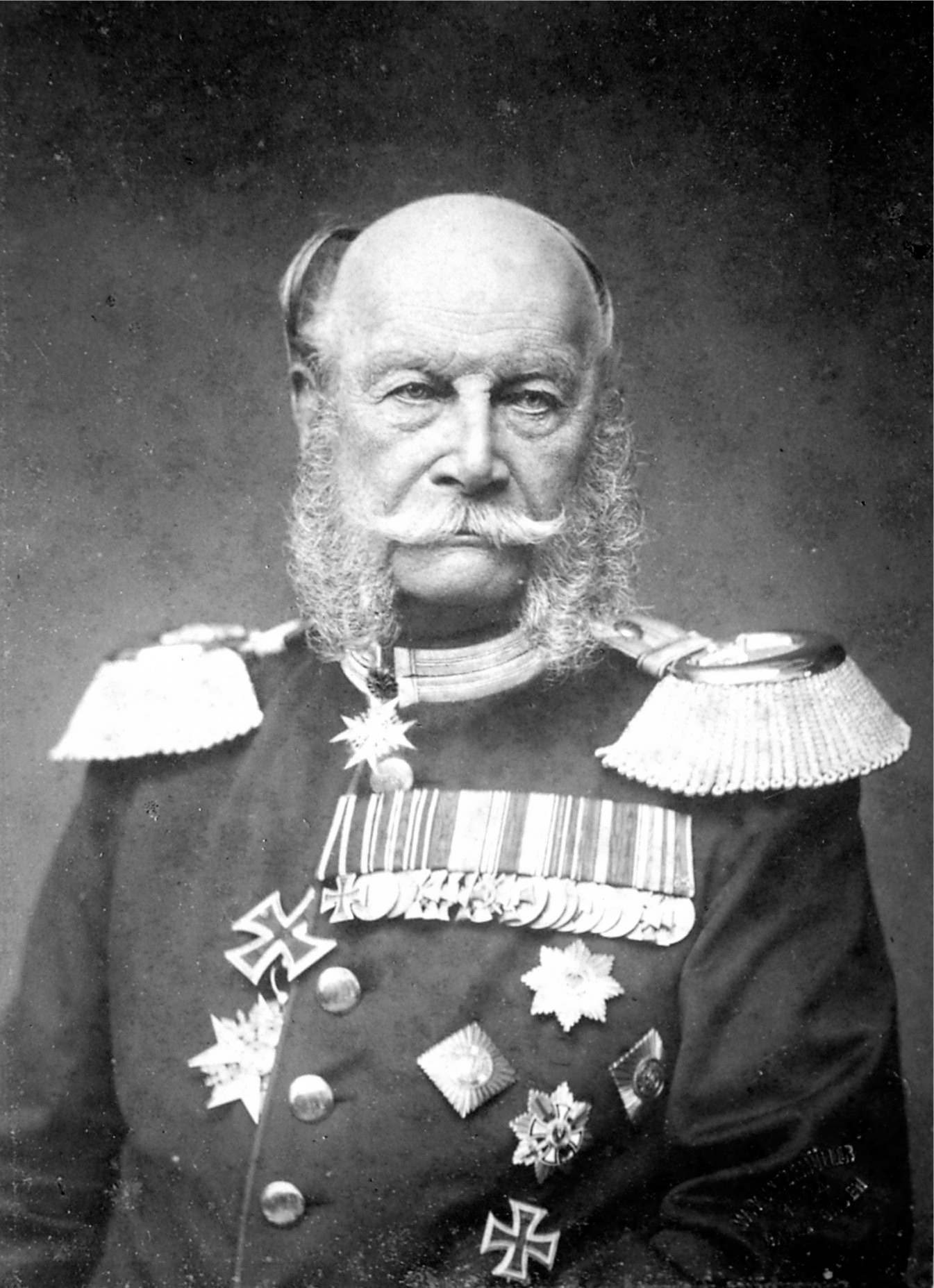
King William I of Prussia didn't particularly want to start a war with France. Indeed, Schulze mentions that he attempted to accede to France's demands (p. 143). France, however, pushed a little too harshly; so when it was required of William to send word to Bismarck as to what had occurred, he framed it as such so that war was inevitable. In a way, it could be said that William himself was a catalyst for German unification.

The effects of this war were far-reaching for Germans. Patriotism reached a definitive high point both for the public and the media—fighting together (and indeed, winning together) gave Germans from across the many lands a new vision of a nation that was truly connected and unified. The Southern and Northern division no longer seemed feasible; why be two separate halves when unification could mean considerably more global power and wealth? This new nation now finally had the approval of both necessary parties: the nobility who yearned for power and the public who wanted better living conditions and national identity.

Despite the many considerable influences, all of this cannot be solely pegged upon victory of the Franco-Prussian war. Rather, the war was definitely a catalyst, and the victory a moment for Germans to devise a new vision for their future as a nation; but this was not the “reason,” nor can there be just one. Many factors were involved, involving international influence as well. In the 1850s, according to Schulze on p. 137, a wave of French nationalism inspired Germans to respond accordingly; if the adage “old habits die hard” has any truth, it can be seen in the France-Germany relationship of the 19th century. Before this, of course, was the initial catalyst: the failed German Revolution of 1848. What caused the Revolution to fail was, at its root, was caused the unification in 1871 to succeed: identity.

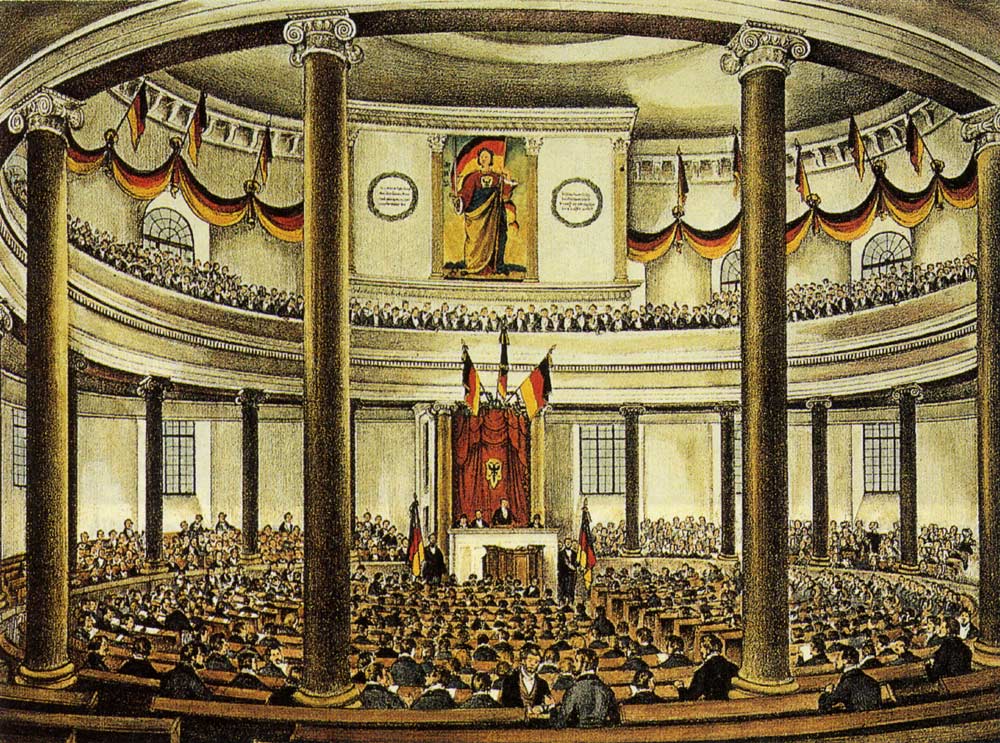
In a parliamentary meeting not much different from this Germans fought endlessly over how to define the nation and who should be ruler. Ultimately, as Schulze concedes, a revolution cannot take hold without clear-cut goals and ideals. The German Revolution of 1848 had neither of those, causing it to inherently fail, at least for the time.


In 1848 Germans working toward unification saw three different solutions, each one giving power to a different party (Schulze p. 126). Despite parliamentary meetings and political fervor, no decision was ever made; ultimately the German people could not decide who was, in fact, German; moreover they could not decide how these Germans would be best represented. By 1871, however, the series of catalysts and motivations gave the Germans a much clearer picture of who they were and what they stood for. It no longer seemed impossible to define Germany’s borders and connect its many cultural roots—Germans were finally inspired to unite in order to combine strength and become a larger presence in Europe and across the globe.

Friday, September 12, 2014

Post 4: Berlin, A City of Contradictions

I will be spending much time in the city of Berlin this December, so I was excited to view Matt Frei’s documentary about this fascinating city with a turbulent past. It was difficult to pick out only three topics of interest, but in the end three ideas stood out among the rest: political contradiction, burying the past, and Berliner identity. All three are intertwined, but each individual idea had a hand in making Berlin the unique metropolis it is today.

Berlin as a city has always been filled with contradictions: its history, and indeed much of the world’s history, was affected greatly by the influence of Frederick the Great, one of the city’s first great contradictions. Frederick was equal parts warrior and philosopher; it was said that he led his troops by day and played music for them at night. Frederick’s two greatest influences, his military-crazed father and the philosopher Voltaire, were polar opposites, and the result was a ruler who left future Berliners at a loss; was this patriarch an absolutist monarch or a believer in education and justice for all classes? This dichotomy followed Berliners through to the second World War, when the Nazi Party, who idolized Frederick as a ruler who fought many battles in the name of Germany’s expansion and military gains, a true, racially pure German; at the same time, however, the Nazi party was suppressing in Berlin some of the very characteristics of Frederick’s more philosophical side: freedom, education, and homosexuality. In the years following the war, the contradictions became more pronounced, when the West vs. East divide also meant a division of ideals. East Berlin, within a short matter of time, went from attempting to mar the name of Frederick to embracing his harsher attributes—once again, ironically idolizing a man whose personal life and beliefs contradicted the message they were trying to portray.


Frederick the Great is, today, a major figure in German history, and while for some time he was demoted to merely "Frederick the Second" it still holds true that, for most of German history, Frederick has been accepted for who he was, a man full of contradictions.


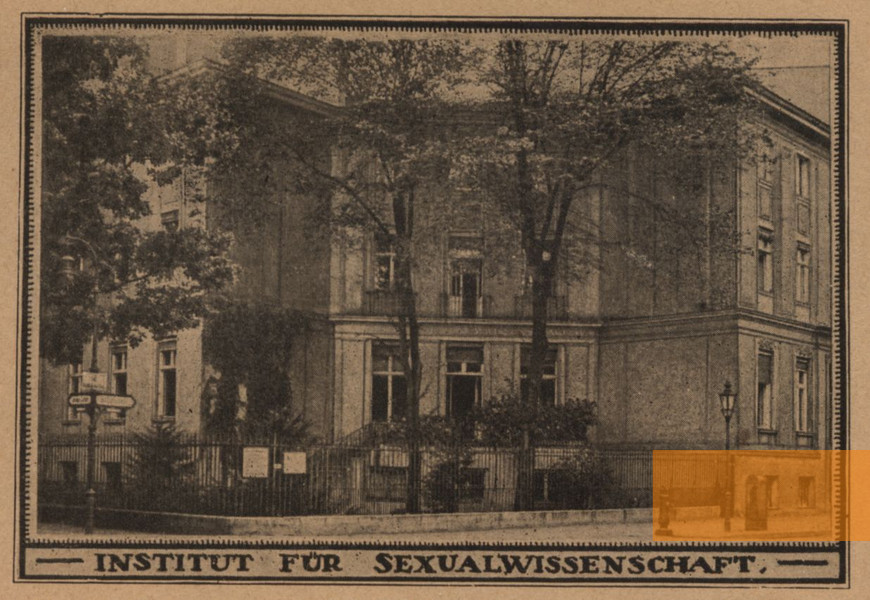
When Goebbels publicly burned the contents of the library of the Institute for Sexual Research, he was sending a very clear message: this sort of knowledge was not acceptable in Nazi Germany. What's interesting, however, is that this sort of history would most likely have fascinated their idol Frederick, who it is often asserted was homosexual himself. In any case, a man who supported the education of all would hardly have enjoyed the burning of a research library.

The split of Berlin into East and West called for another interesting trend, that of burying the past. The end of WWII left Berliners with a city full of memories that most were all too willing to forget. On both sides of Berlin were relics of past moments, ideas that neither reflected nor supported the current ideals of Berlin’s leaders, on either side. Because of this, both the destruction of historical buildings and the creation of new structures had a drastic effect on the city and its people. Whether it be the destruction of Hitler’s Chancellery and repurposing of materials into a monument to fallen Russians, building (and later tearing down) a virtual landmark for East Germans on the site of the Prussian monarchs’ palace, or the construction of the Berlin Wall through towns, families, and even graveyards, buildings and monuments in Berlin are much more than places of residence and business; they are often a way for the government (or occasionally the people) to present a new ideal in the place of an old one.


The Schloss, the palace of many Prussian Royals, was considered before WWII to be one of the greatest German landmarks in Berlin. After the war it was in major disrepair, the perfect excuse for East German communist political forces to demolish it. Many Berliners on both sides of the wall were stricken by the destruction of such a landmark; today, there is talk of replicating the monument on its original site.


East Germany's response to the Schloss was the Palace of the Republic, the site of many social activities for East Berlin's inhabitants. The building, an insult to some, gave others a sense of community that had previously been absent in this side of the city. When it was torn down in 2006, it was not replaced by anything at all; the decision of whether to erase one history in order to rectify another is difficult even today.

Through all of this, Berliners have lived in their city, whether united or divided. But the identity of a Berliner is hard to define. During the war, many of the “rubble women” were left behind to clean and care for the city, often seen as prizes for invading soldiers while still maintaining a stronghold on their homes and families. After the construction of the Wall, hundreds of East Berliners jumped out of windows in an effort to join their Western brethren, even at risk of death—once again a people divided, yet still aiming to join together. One could say that, after the destruction of the Berlin Wall, East and West found themselves in an interesting position: with a unified Berlin, what was left of East Berliners’ identities? This question is still being answered today, more than 20 years after the fall of the Wall, and will likely still be asked many years from now.


When 77-year-old Frida Schulze climbed out the window and into Western Berlin, she symbolized the sentiment of many Berliners--suspension between two ideals, two worlds, East and West. Frida was one of many who attempted to cross the gap; some were successful, but others were pulled back (and no doubt severely punished) by the East Berlin police. To this day Frida's image serves as a reminder of what some will do for the ski of freedom.


Despite war, destruction, and political turmoil, Berliners have always persevered. Their history runs deep, and their culture draws in visitors from across the globe, as it has for centuries. Berlin is a city full of contradictions, trying to bury the past while maintaining identity; and yet, that may be what is so interesting about Berliners all along—the contradiction is what makes them so unique, and yet so easily able to pique the interest of so many for so long.

WC: 722