I will be spending much time in the city of Berlin this
December, so I was excited to view Matt Frei’s documentary about this
fascinating city with a turbulent past. It was difficult to pick out only three
topics of interest, but in the end three ideas stood out among the rest:
political contradiction, burying the past, and Berliner identity. All three are
intertwined, but each individual idea had a hand in making Berlin the unique
metropolis it is today.
Berlin as a city has always been filled with contradictions:
its history, and indeed much of the world’s history, was affected greatly by
the influence of Frederick the Great, one of the city’s first great
contradictions. Frederick was equal parts warrior and philosopher; it was said
that he led his troops by day and played music for them at night. Frederick’s
two greatest influences, his military-crazed father and the philosopher
Voltaire, were polar opposites, and the result was a ruler who left future
Berliners at a loss; was this patriarch an absolutist monarch or a believer in
education and justice for all classes? This dichotomy followed Berliners
through to the second World War, when the Nazi Party, who idolized Frederick as
a ruler who fought many battles in the name of Germany’s expansion and military
gains, a true, racially pure German; at the same time, however, the Nazi party
was suppressing in Berlin some of the very characteristics of Frederick’s more
philosophical side: freedom, education, and homosexuality. In the years
following the war, the contradictions became more pronounced, when the West vs.
East divide also meant a division of ideals. East Berlin, within a short matter
of time, went from attempting to mar the name of Frederick to embracing his
harsher attributes—once again, ironically idolizing a man whose personal life
and beliefs contradicted the message they were trying to portray.
 Frederick the Great is, today, a major figure in German history, and while for some time he was demoted to merely "Frederick the Second" it still holds true that, for most of German history, Frederick has been accepted for who he was, a man full of contradictions.
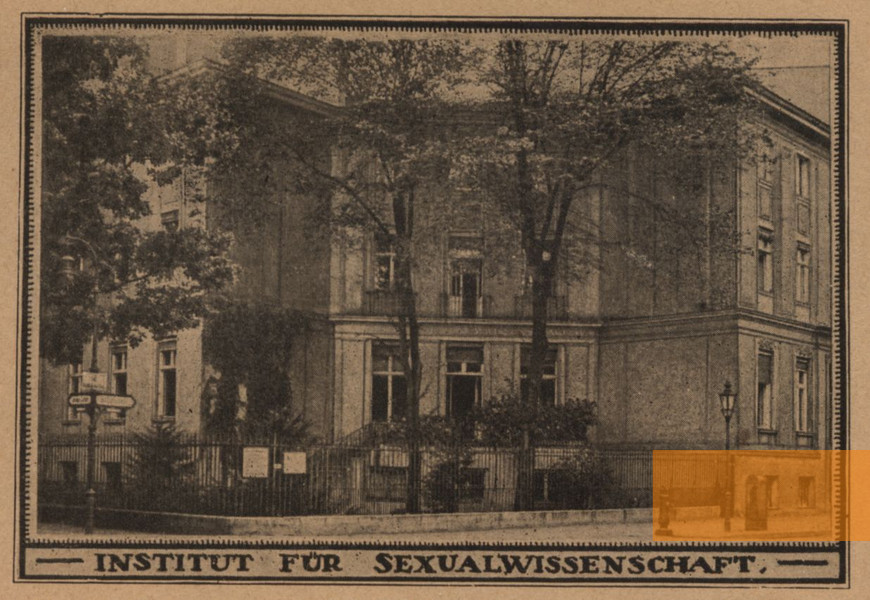 When Goebbels publicly burned the contents of the library of the Institute for Sexual Research, he was sending a very clear message: this sort of knowledge was not acceptable in Nazi Germany. What's interesting, however, is that this sort of history would most likely have fascinated their idol Frederick, who it is often asserted was homosexual himself. In any case, a man who supported the education of all would hardly have enjoyed the burning of a research library.
The split of Berlin into East and West called for another
interesting trend, that of burying the past. The end of WWII left Berliners
with a city full of memories that most were all too willing to forget. On both
sides of Berlin were relics of past moments, ideas that neither reflected nor
supported the current ideals of Berlin’s leaders, on either side. Because of
this, both the destruction of historical buildings and the creation of new
structures had a drastic effect on the city and its people. Whether it be the
destruction of Hitler’s Chancellery and repurposing of materials into a
monument to fallen Russians, building (and later tearing down) a virtual landmark
for East Germans on the site of the Prussian monarchs’ palace, or the
construction of the Berlin Wall through towns, families, and even graveyards,
buildings and monuments in Berlin are much more than places of residence and
business; they are often a way for the government (or occasionally the people)
to present a new ideal in the place of an old one.
 The Schloss, the palace of many Prussian Royals, was considered before WWII to be one of the greatest German landmarks in Berlin. After the war it was in major disrepair, the perfect excuse for East German communist political forces to demolish it. Many Berliners on both sides of the wall were stricken by the destruction of such a landmark; today, there is talk of replicating the monument on its original site.
 East Germany's response to the Schloss was the Palace of the Republic, the site of many social activities for East Berlin's inhabitants. The building, an insult to some, gave others a sense of community that had previously been absent in this side of the city. When it was torn down in 2006, it was not replaced by anything at all; the decision of whether to erase one history in order to rectify another is difficult even today.
Through all of this, Berliners have lived in their city,
whether united or divided. But the identity of a Berliner is hard to define.
During the war, many of the “rubble women” were left behind to clean and care
for the city, often seen as prizes for invading soldiers while still
maintaining a stronghold on their homes and families. After the construction of
the Wall, hundreds of East Berliners jumped out of windows in an effort to join
their Western brethren, even at risk of death—once again a people divided, yet
still aiming to join together. One could say that, after the destruction of the
Berlin Wall, East and West found themselves in an interesting position: with a
unified Berlin, what was left of East Berliners’ identities? This question is
still being answered today, more than 20 years after the fall of the Wall, and
will likely still be asked many years from now.
 When 77-year-old Frida Schulze climbed out the window and into Western Berlin, she symbolized the sentiment of many Berliners--suspension between two ideals, two worlds, East and West. Frida was one of many who attempted to cross the gap; some were successful, but others were pulled back (and no doubt severely punished) by the East Berlin police. To this day Frida's image serves as a reminder of what some will do for the ski of freedom.
Despite war, destruction, and political turmoil, Berliners
have always persevered. Their history runs deep, and their culture draws in
visitors from across the globe, as it has for centuries. Berlin is a city full
of contradictions, trying to bury the past while maintaining identity; and yet,
that may be what is so interesting about Berliners all along—the contradiction
is what makes them so unique, and yet so easily able to pique the interest of
so many for so long.
WC: 722

No comments:
Post a Comment